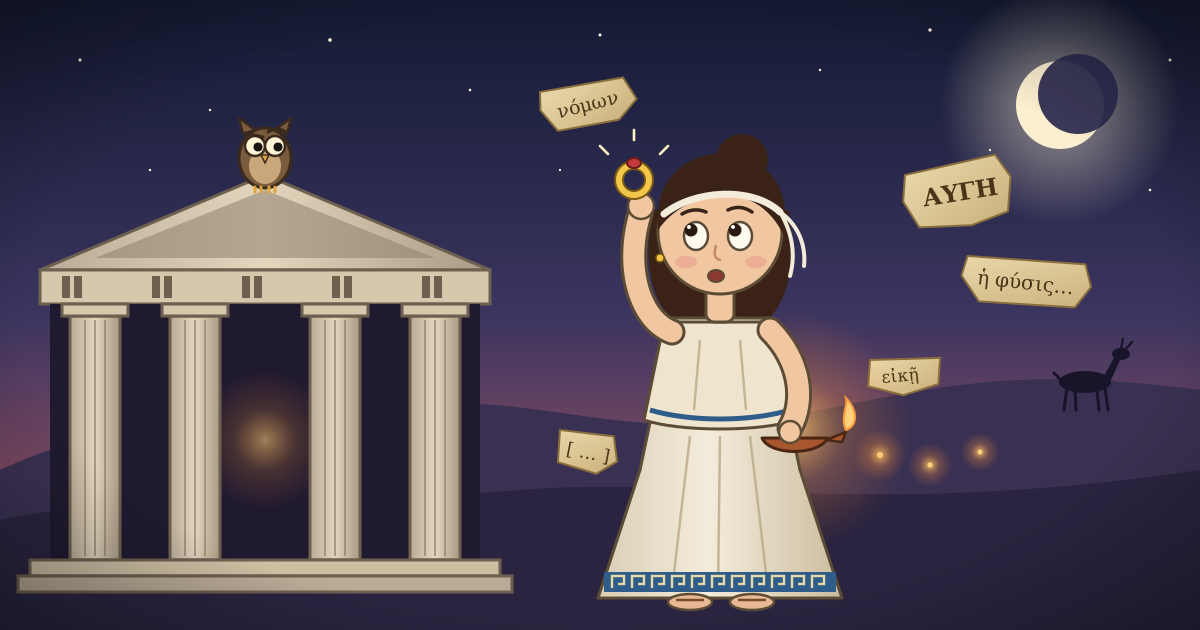
The Search for Auge
Euripides wrote a play about a priestess who gave birth inside a temple. It is gone, but Diogenes Laertius, Plato, a comic poet, and a travel writer each kept a piece of it without meaning to.
Of the ninety-odd plays Euripides wrote, eighteen or nineteen survive whole. The rest exist the way a shipwreck exists: a few planks on a beach, a bottle with half a message, a sailor in a tavern who remembers the captain's name. *Auge* is one of the wrecks. No manuscript of it survives. What remains is a few dozen lines quoted by later writers, a joke in Aristophanes, a plot borrowed by a comedian, and an anecdote about Socrates walking out of the theatre.
That is enough to go looking. This piece is a record of the search, and of two witnesses who turned up along the way and turned out to matter more than expected: Diogenes and Plato.
The story, as far as it can be pieced together
Auge was the daughter of Aleus, king of Tegea in Arcadia, and a priestess of Athena Alea. Heracles passed through Tegea, got drunk at a night festival, and raped her. She hid the pregnancy and gave birth inside the goddess's precinct. The birth polluted the sanctuary, and the land suffered for it. Aleus found out, ordered the child exposed on a mountainside, and handed his daughter over to be drowned or sold abroad.
The child, Telephus, was suckled by a deer and lived. Heracles came back, and a ring he had left with Auge seems to have served as the token by which mother, child, and father were recognized. The play probably ended with a god stepping in to send Auge and Telephus east to Mysia, where Telephus would later grow up to be a king and to fight the Greeks on their way to Troy.
Every sentence in that summary leans on someone other than Euripides. The outline comes from later mythographers and from a handful of ancient summaries of the play; the ring comes from a late rhetorical handbook; the setting comes from Pausanias, who visited Tegea in the second century AD and described the temple of Athena Alea. In the market place he found a sanctuary of Eileithyia, goddess of childbirth, whose statue the Tegeans called "Auge on her knees." Their story was that Aleus handed his daughter to Nauplius to be drowned at sea, and that on the way she fell to her knees and gave birth on the spot where the sanctuary now stands. The local version puts the birth in the street, not the temple. Euripides himself is mostly absent from his own plot.
The joke that dates it
The first fixed point is a complaint. In Aristophanes' *Frogs*, staged in 405 BC, the ghost of Aeschylus lists the damage Euripides has done to Athens. Among the charges: he put on stage women "giving birth in the temples."
Only one play fits. A joke has to land with an audience, so *Auge* must have been recent enough and notorious enough that nobody in the theatre needed it explained. That places it in the last years of Euripides' life, probably around 408, and it tells something about how it was received. Of everything in the play, the birth in the sanctuary was the image that stuck.
What Auge said in her defence
Among the surviving fragments, a few lines stand out because they are an argument, and the argument is aimed at a goddess. Auge, accused of polluting Athena's house, points out that the goddess delights in spoils stripped from the dead, in armour hung on temple walls, yet counts a woman in childbirth as defilement. Death is welcome in the precinct; birth is not.
Euripides liked this argument enough to use it twice. In *Iphigenia among the Taurians*, Iphigenia makes the same complaint against Artemis, who bars from her altar anyone who has touched a corpse or a newborn, yet takes pleasure in human sacrifice. In both plays the charge is the same: the gods' rules about purity do not hang together, and mortals pay for the inconsistency.
A second line, preserved because a comic poet quoted it, is blunter still: "Nature willed it, and nature cares nothing for laws. Woman was born for this." That line will come back.
Diogenes and the man who walked out
The most vivid witness to *Auge* never mentions its plot. Diogenes Laertius, writing his *Lives of the Eminent Philosophers* some six centuries later, records that when a line from *Auge* was spoken in the theatre, Socrates stood up and left. The line was said to be about virtue: "best to let these things wander loose, at random." Socrates' reason for leaving, as Diogenes reports it, was that it was absurd to think a runaway slave worth searching for, yet to let virtue go missing without a search.
The anecdote is almost certainly polished, and it may be invented. There is also a snag in the line itself. It stands word for word in Euripides' surviving *Electra* (line 379), where Orestes, having found that birth and wealth are no sure test of a man's worth, concludes that such judgements are best left loose. Nauck, the nineteenth-century editor of the fragments, thought Diogenes had simply remembered the wrong play; Wilamowitz held that the line could have stood in both. Even if it did, the line in its original context need not have been about virtue at all, and a character in a tragedy can say something foolish without the poet endorsing it. So as evidence for a lost play the anecdote is shaky. It may not even preserve a line of *Auge*. What it does show is a later age treating *Auge* as a play worth arguing with, one that put a dangerous idea in the air and needed a philosopher to walk out on it.
There is also a pleasing fit between the anecdote and this whole project. Socrates' complaint is about searching: people go looking for lost property and not for lost goods of the mind. The search for *Auge* is a minor example of the opposite habit. Nobody can sell a lost tragedy, and still people have spent centuries combing anthologies and papyri for scraps of it.
The other Diogenes, the Cynic from Sinope, belongs in the search as well, though as a sympathizer rather than a witness. Diogenes Laertius reports that the Cynic saw nothing out of place in taking things from a temple, and that he set nature above custom at every turn. "Nature cares nothing for laws" could stand as a motto over his tub. If Socrates walked out of *Auge*, the Cynic would likely have stayed for the speech in Auge's defence, and applauded.
Plato and the women on stage
Plato never names *Auge*, so far as survives, but he wrote as if he had it in mind.
In the third book of the *Republic*, Socrates sets out what the guardians of the ideal city may imitate in poetry and performance. They must not imitate women, and in particular not a woman quarrelling with her husband, or boasting against the gods, or in sickness, or in love, or in labour. The list reads like a description of what Athenian tragedy had been showing its audience, and a woman in labour, defying a goddess, in a temple, is about as precise a match for *Auge* as the list could offer. Whether or not Plato was thinking of that play in particular, his censor would have cut it first.
The deeper connection runs through the line that drove Socrates out. In the *Meno*, Plato has Socrates spend a whole dialogue asking whether virtue can be taught. The answer reached at the end is uncomfortable: virtue seems to come neither by nature nor by teaching, but "by divine dispensation," without understanding on the part of those who have it. That is not far from letting virtue wander loose. The Socrates of the anecdote walks out on the idea; the Socrates of the *Meno* arrives at something close to it and admits that the search is not finished. Plato, who spent his life writing up that search, may have been the person most able to see that Euripides had a point.
The comedian who kept the plot
The last witness is the one that preserves the most. Menander, writing comedy in Athens about eighty years after *Auge*, built his *Epitrepontes* (*The Arbitration*) on the same frame. A young woman is assaulted at a night festival by a drunk young man she cannot identify. She bears a child in secret. The baby is exposed with tokens, among them a ring, and the ring leads to recognition and reconciliation.
Menander does not hide the debt. One of his characters quotes *Auge* outright, including the line about nature caring nothing for laws, and threatens to recite whole speeches from it. The joke depends on the audience knowing the tragedy well. Two generations after Euripides died, *Auge* was still common property, familiar enough to parody, which is the surest sign a play was being performed and read.
So the shape of the lost play survives inside a comedy, moved from a temple to a household and from gods to fathers-in-law. The pollution argument is gone; the ring, the festival, the drunkenness, and the exposed child are intact.
What the search turns up
Put the pieces side by side and a play comes into view. It was late, scandalous, and argumentative. It put a woman's body at the centre of a quarrel about sacred law and let her win at least part of the argument. Its most quoted lines were provocations: nature against law, birth against death, and, if Diogenes remembered rightly, virtue left to chance. Aristophanes mocked it, Socrates (by report) refused to sit through it, Plato legislated against plays like it, the Cynic would have cheered it, and Menander stole its plot.
None of those people set out to preserve *Auge*. They quoted it to win an argument, to land a joke, or to illustrate a point about virtue. That is how most of ancient literature survives: not in vaults but in the teeth of the people who disagreed with it. A play that nobody objected to would have left nothing behind.
The play itself is still lost. The quarrel it started is not.