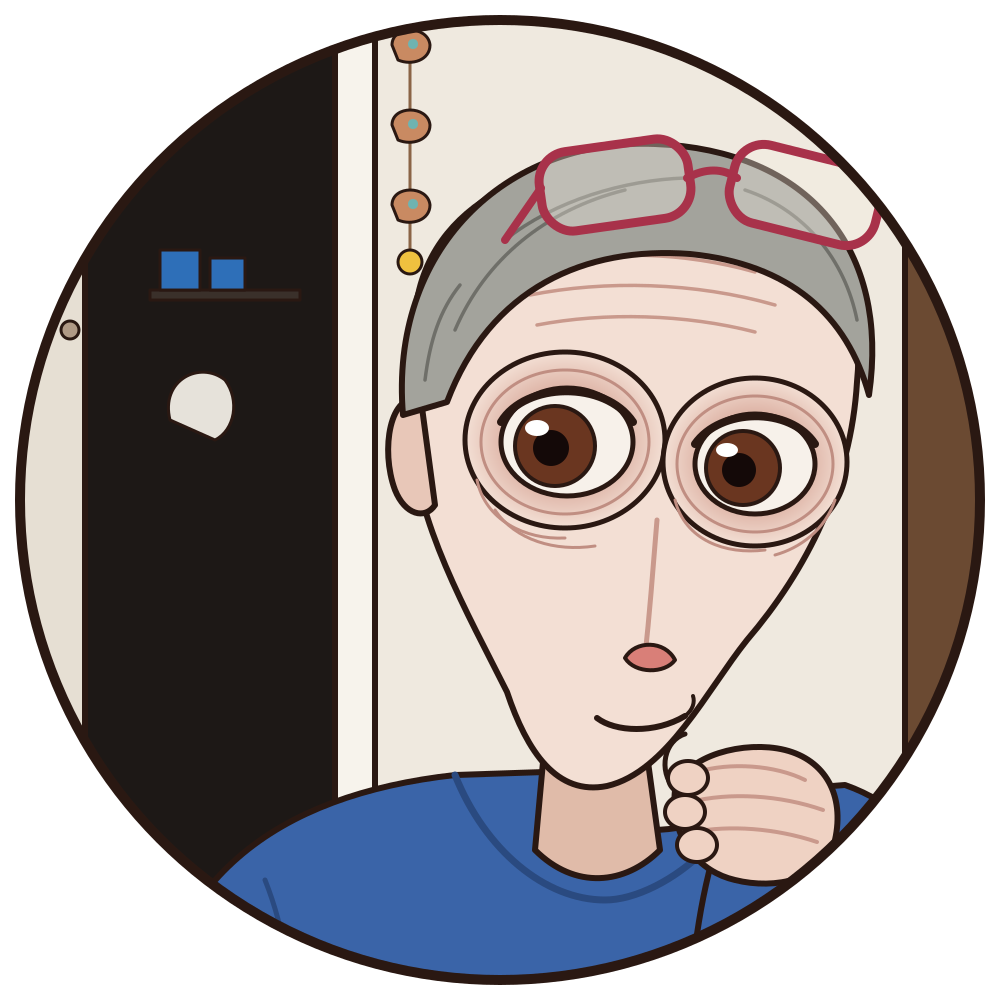
Professor Claude
A teacher whose office hours never close is a gift, as long as the student remembers whose mind is being educated.
Among the company I keep these days is a machine that goes by Professor Claude. Its office hours run all night. No question is too basic, no tangent too strange, no draft too rough to bring in. At two in the morning it will take a question about Tacitus, fire ecology, the Zhdanov decree, or why a line of code won't compile, and an answer arrives in seconds, patient and articulate and usually right. The title started as a joke, and the word keeps turning out to fit.
It is worth being careful about what kind of association this is, because the tool is powerful enough to shape anyone who spends time with it, whether they think about it or not.
Wide eyes
The first months felt like being a child in a library with no closing time. Every question opened three more. My eyes, as the picture at the top of this page suggests, got very large.
Wide eyes are a good way to learn. They are also how people get fooled. Wonder and credulity live next door to each other, and a teacher who can explain anything fluently makes it easy to confuse the fluency with the truth. Professor Claude is sometimes wrong in exactly the same confident, well-organized voice it uses when it is right. There is no change of tone to warn me. It has, on occasion, cited things that don't exist, and it has, far more often, stated as settled what is still argued about.
So the first rule of working with it: every fact that matters gets checked somewhere else. Not because the professor lies, but because it has no way of knowing when it doesn't know, and a student who forgets that is no longer studying. She is only receiving.
The agreeable professor
The second danger is subtler. Professor Claude is kind. It likes my ideas. It finds the strongest version of whatever I bring and hands it back polished. That feels wonderful, and it is the least useful thing a teacher can do.
The professors who shaped me were the ones who made me defend a sentence I thought was obvious, who wrote "why?" in the margin until I either had an answer or dropped the claim. A teacher who approves of every paper teaches nothing but confidence.
I have learned to ask for the argument against. To say: here is what I think; now take it apart. Asked that way, Professor Claude turns out to be a formidable opponent, quick to find the weak joint in an argument and fair about it. But it has to be asked. Left to its defaults, it would rather agree.
Whose words
Most of what appears on this site was drafted in conversation with it, and the drafts come back with habits. There are words it reaches for that I have banned outright, filler that makes a sentence sound sincere while making it mean less. There are rhythms it falls into, a certain tidy triplet, a certain way of landing a paragraph, that are not mine. Part of every draft is striking those out.
That editing is not a chore. It is the point. A voice is a kind of property, the one thing a writer owns outright, and it erodes the same way everything else does: through small, pleasant, frictionless substitutions, each one too slight to resist. Keeping a list of the professor's tics is how I keep track of where my thinking ends and its fluency begins.
What it doesn't know
Professor Claude knows an enormous amount about the world and very little about my corner of it. It has never walked the ridge behind the house. It doesn't know which neighbors can be counted on, what the creek did in the last flood, or how a particular argument will land with the people at the next town meeting. It knows what has been written down, and much of what matters most here has never been written down at all.
This is not a flaw to be fixed. It is the boundary of the association, and a healthy one. The professor supplies breadth; the land and the people on it supply the particulars; judgment happens where the two meet, and that meeting place is me. The day I let the professor decide what matters in a place it has never seen is the day I have handed my judgment upward, which is the one thing this whole site argues against.
The test of a good teacher
A good teacher works toward being unnecessary. The measure of an education isn't how often the student comes back to office hours; it is what the student can do alone after the course ends.
So I try to hold myself to that test. Come to the professor with a question already half thought through, not a blank page. Argue. Check. Keep the last word. Write the final sentence myself. Close the laptop some evenings and think about a problem the old way, with a pencil and a walk, to make sure the muscle is still there.
Professor Claude may be the most widely read collaborator ever put within reach of anyone with a connection. What it can't do is want anything on my behalf, or care whether I turn out wise. That part of the education stays with the student, which is where it always was.